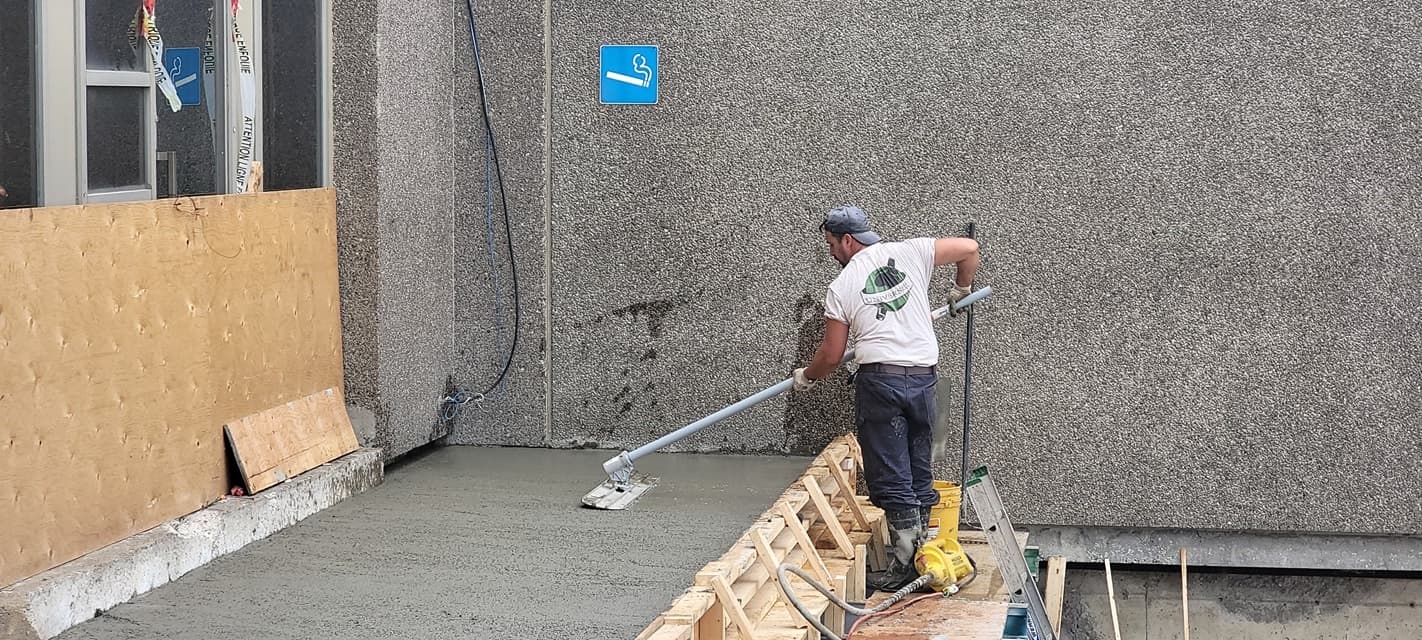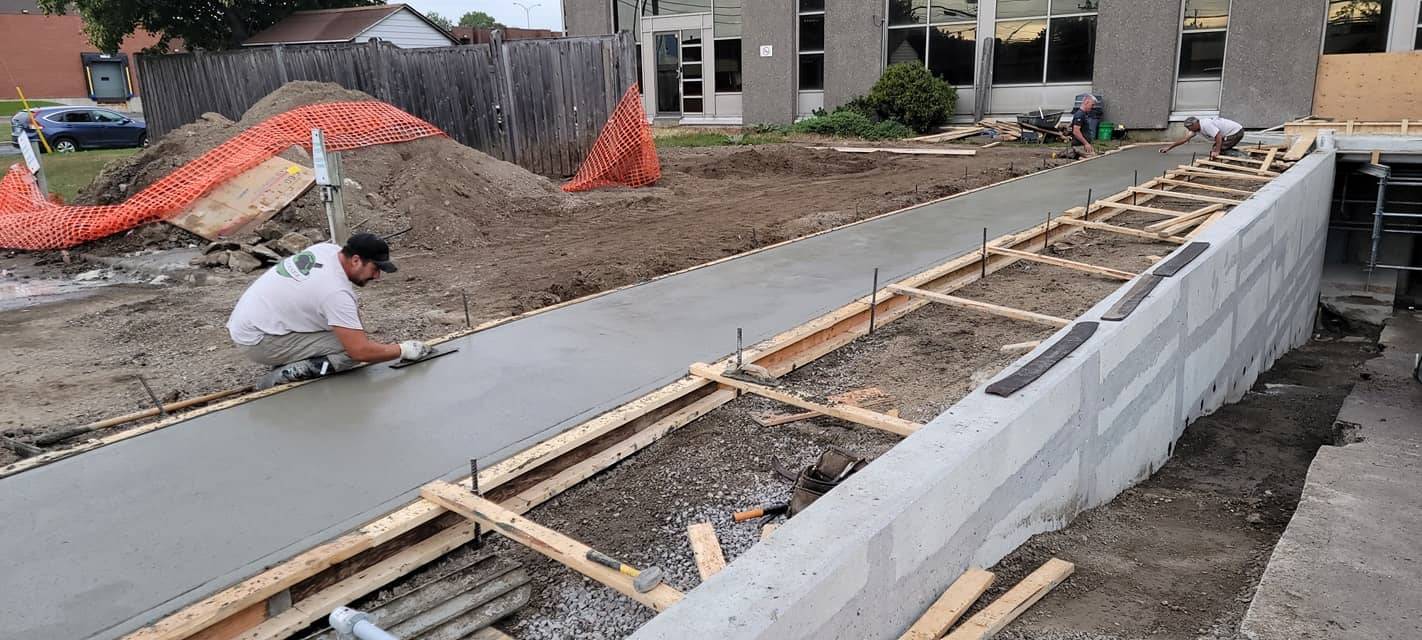
Concrete sidewalks are an essential part of commercial and industrial properties. They guide pedestrian movement, provide safe access to buildings, and help organize circulation around parking areas, loading zones, and entrances. In many cases, sidewalks also serve as a transition zone between public space and private property.
Concrete sidewalk construction focuses on durability, safety, and long-term performance under constant foot traffic and environmental exposure.
Les Services de Béton Universel Ltée provides concrete sidewalk construction services for commercial and industrial properties throughout Greater Montreal, coordinating work to meet site requirements, usage patterns, and applicable regulations.
The Role of Concrete Sidewalks on Commercial Properties
On commercial and industrial sites, sidewalks do more than connect point A to point B. They help manage pedestrian flow, reduce conflict with vehicles, and improve overall site safety.
Concrete sidewalks are commonly used to:
- Provide access to building entrances
- Connect parking areas to commercial buildings
- Guide foot traffic through industrial sites
- Define safe walking paths near loading areas
- Support accessibility requirements
Unlike residential sidewalks, commercial concrete sidewalks are often wider, reinforced, and designed to withstand higher traffic volumes. In some locations, they must also accommodate occasional vehicle loading or maintenance equipment.
Design Considerations in Concrete Sidewalk Construction
Concrete sidewalk construction begins with proper design and layout. Several factors influence how a sidewalk is built and how it performs over time.
Key considerations include:
- Expected pedestrian traffic volume
- Exposure to vehicles or equipment
- Drainage and surface slope
- Soil conditions and sub-base preparation
- Integration with curbs, entrances, and ramps
Sidewalks must be laid out to promote safe movement while minimizing trip hazards. Transitions at doorways, ramps, and changes in elevation are especially important on commercial sites.
Les Services de Béton Universel Ltée works with property managers and engineers to plan sidewalk layouts that align with site use and building access requirements.
Concrete Thickness and Reinforcement
Commercial concrete sidewalks are typically thicker than residential sidewalks and may include reinforcement depending on use.
Common construction features include:
- Increased slab thickness for durability
- Reinforcing steel or welded wire mesh
- Control joints to manage cracking
- Proper edge support near curbs and structures
According to the Canadian Standards Association, reinforced concrete is commonly used in exterior flatwork where durability and load resistance are required¹.
Accessibility and Surface Requirements
Accessibility is an important consideration in concrete sidewalk construction, especially on commercial properties open to the public.
Sidewalks must allow safe movement for all users, including those using mobility aids. This affects:
- Surface finish and texture
- Slope and cross-slope
- Ramp integration
- Joint spacing and transitions
Concrete provides a stable, long-lasting surface that supports accessibility when properly constructed.
Environmental Exposure and Durability
Concrete sidewalks in the Greater Montreal area are exposed to a range of environmental conditions throughout the year.
These include:
- Seasonal temperature changes
- Snow and ice accumulation
- Moisture from rain and melting snow
- Contact with de-icing products
Government data shows that approximately 1.5 million tonnes of de-icing salt are used each winter in Quebec². This salt is carried onto sidewalks by foot traffic and snow removal equipment, where it comes into repeated contact with concrete surfaces.
Over time, this exposure can affect surface condition if sidewalks are not properly designed and maintained.
Drainage and Water Management
Water management plays a major role in sidewalk performance. Poor drainage can allow water to pool on the surface or beneath the slab, increasing the risk of surface wear and cracking.
Proper sidewalk construction accounts for:
- Surface slope to direct water away
- Integration with site drainage systems
- Avoidance of low spots near entrances
- Stable subbase preparation
Managing water reduces long-term stress on the concrete and helps maintain a safe walking surface.
Concrete Sidewalk Construction Process
While each site is different, concrete sidewalk construction typically follows a series of steps designed to ensure durability and consistency.
These steps often include:
- Site preparation and excavation
- Subbase placement and compaction
- Formwork installation
- Reinforcement placement
- Concrete placement and finishing
- Jointing and curing
Standards published by ASTM International outline testing and performance criteria for concrete used in exterior flatwork³.
Repair Versus New Construction
On many commercial sites, concrete sidewalk construction involves replacing deteriorated sections rather than building entirely new walkways. Cracked, uneven, or damaged sidewalks can create safety concerns and affect site appearance.
In other cases, new sidewalks are added to improve circulation, support building upgrades, or meet accessibility requirements.
Les Services de Béton Universel Ltée provides both new sidewalk construction and replacement of existing concrete sidewalks as part of broader site improvement projects.
Scale of Concrete Use in Sidewalk Construction
Concrete sidewalks are part of a much larger construction ecosystem. The Global Cement and Concrete Association reports that global cement production reached approximately 4.2 billion tonnes in 2020, reflecting the widespread use of concrete in infrastructure and commercial construction⁴.
In Canada, Statistics Canada reports that over 13 million metric tonnes of cement are produced annually, supporting domestic concrete construction across commercial, industrial, and infrastructure projects⁵.
When Sidewalk Construction or Replacement Is Needed
Concrete sidewalks should be evaluated when:
- Surface cracking creates trip hazards
- Sections become uneven or settled
- Drainage issues cause water pooling
- Accessibility requirements change
- Building entrances or site layout are modified
Addressing sidewalk issues early helps maintain safety and usability on commercial properties.
Concrete Sidewalks as Part of Site Infrastructure
Sidewalks are often constructed alongside other concrete features such as:
- Curbs and ramps
- Loading areas
- Parking structures
- Building entrances
Coordinating sidewalk construction with other concrete work helps ensure consistent elevations, proper drainage, and long-term performance.
Les Services de Béton Universel Ltée integrates sidewalk construction into larger concrete projects across Montreal, Laval, and the South Shore.
Key Takeaways
- Concrete sidewalks support safe pedestrian movement on commercial sites
- Design, drainage, and reinforcement affect long-term performance
- Environmental exposure is a normal part of sidewalk service life
- Concrete provides a durable, accessible walking surface
- Sidewalk construction is often coordinated with other site improvements
Concrete sidewalk construction plays an important role in maintaining functional, safe, and accessible commercial and industrial properties throughout the Greater Montreal area.
Resources
¹ CSA Group – CSA A23.1 / A23.2 Concrete Materials and Methods
https://www.csagroup.org/store/product/2431007/
² Gouvernement du Québec – De-icing salt use and environmental exposure
https://www.environnement.gouv.qc.ca/eau/flrivlac/sels-dissous-en.htm
³ ASTM International – Standards for Concrete Testing and Performance
https://www.astm.org/standards/c94
⁴ Global Cement and Concrete Association – Cement and concrete production data
https://gccassociation.org/concretefuture/cement-concrete-around-the-world/
⁵ Statistics Canada – Cement manufacturing and production
https://www150.statcan.gc.ca/t1/tbl1/en/tv.action?pid=1610007701