Concrete slab construction is a foundational part of commercial and industrial buildings. Concrete Slabs provide durable, level surfaces that support foot traffic, vehicles, equipment, storage systems, and day-to-day operations. In many facilities, slabs also serve as the interface between structural elements, embedded services, and finished surfaces.
Proper concrete slab construction ensures long-term performance, safety, and usability under demanding conditions.
Les Services de Béton Universel Ltée provides concrete slab construction services for commercial and industrial projects throughout Greater Montreal, delivering slabs designed for durability, load requirements, and site conditions.
What Concrete Slabs Do in Commercial and Industrial Buildings
Concrete slabs form the working surface of many buildings. Depending on design and use, slabs may:
- Support vehicle and forklift traffic
- Carry static and dynamic equipment loads
- Serve as finished floors or base surfaces
- Integrate drainage, joints, and embedded services
Concrete Slabs also distribute loads to the ground or to supporting structural elements such as beams and columns.
Because slabs are directly exposed to daily use, construction quality plays a major role in long-term performance.
Types of Concrete Slabs
Concrete slab construction varies based on building design and usage.
Common slab types include:
- Slabs-on-grade, supported directly by soil
- Industrial slabs, designed for heavy equipment and traffic
- Structural slabs, supported by beams and columns
- Parking slabs, exposed to vehicles and moisture
Each type has different design requirements related to thickness, reinforcement, and surface finish.
Slab Thickness and Load Requirements
Concrete Slab thickness is determined by load demands, sub-base conditions, and intended use.
Typical slab thickness ranges include:
- 100 mm to 125 mm for light commercial applications
- 150 mm to 200 mm for standard industrial use
- 200 mm and greater for heavy-duty industrial environments
Heavier loads often require increased thickness and reinforcement to control cracking and deflection.
Engineering design considers both load magnitude and load repetition, especially where forklifts, pallet racks, or machinery are involved.
Sub-base Preparation and Support
A concrete slab performs only as well as the support beneath it. Sub-base preparation is one of the most important steps in slab construction.
Key subbase considerations include:
- Soil type and load bearing capacity
- Compaction of granular materials
- Uniform support across the concrete slab area
- Drainage and moisture control
The National Research Council of Canada notes that uneven or poorly compacted sub-bases can lead to settlement and slab cracking³.
Proper preparation helps ensure uniform load transfer and long-term stability.
Reinforcement in Concrete Slabs
Reinforcement helps control cracking and improve load distribution within a concrete slab.
Common reinforcement options include:
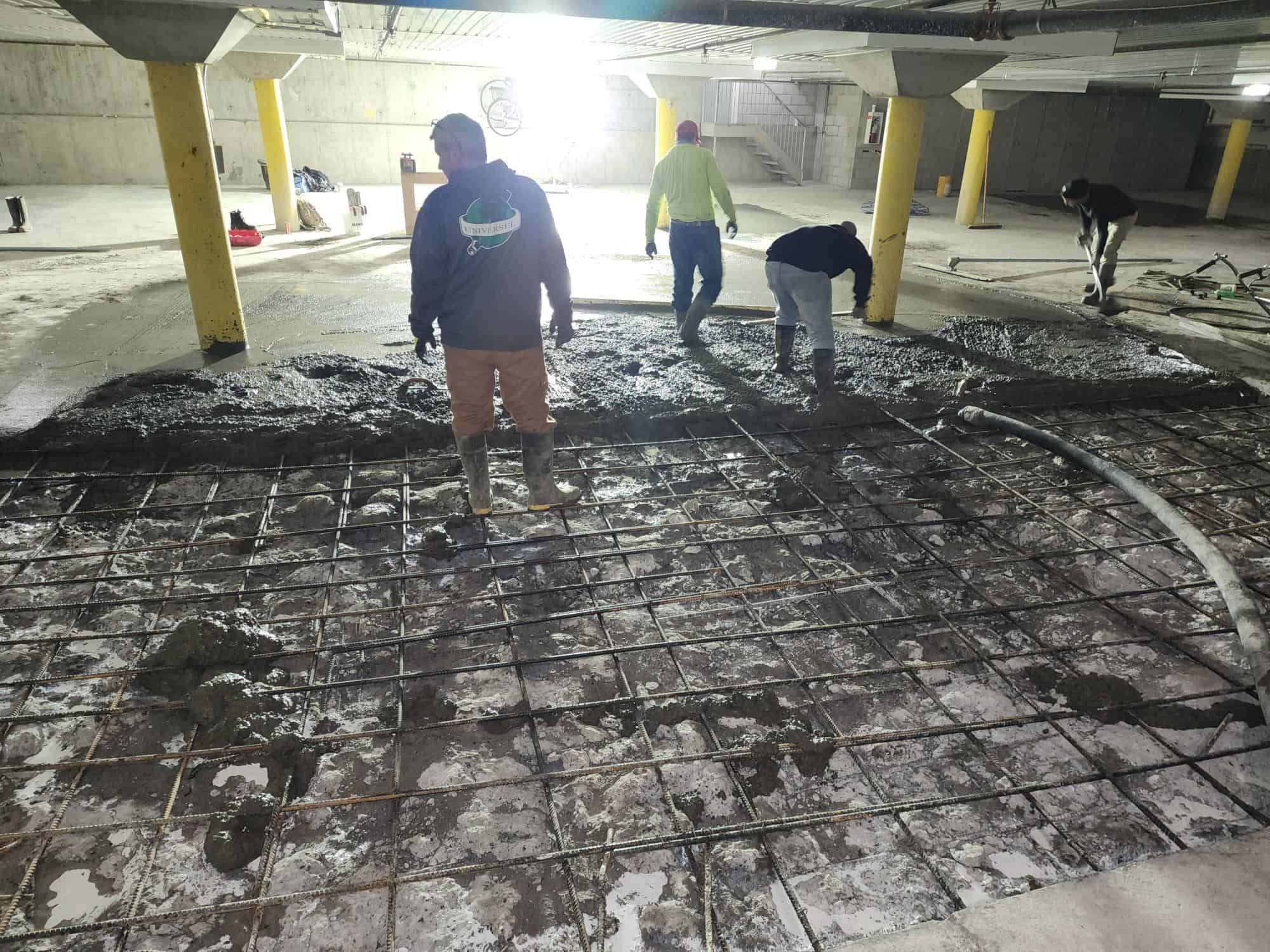
- Welded wire mesh
- Reinforcing bars
- Fiber reinforcement
Reinforcement selection depends on slab thickness, load requirements, and joint spacing.
Canadian concrete standards outline reinforcement practices used in commercial slab construction².
Joint Layout and Crack Control
Concrete shrinks as it cures. Joints are used to control where cracks occur and to reduce random cracking.
Common joint types include:
- Control joints
- Construction joints
- Isolation joints
Proper joint spacing and layout are essential for slab performance. Poor joint planning can result in uncontrolled cracking and premature surface wear.
Concrete Placement and Finishing
Concrete placement and finishing directly affect slab durability and surface quality.
Key steps include:
- Proper concrete delivery and placement
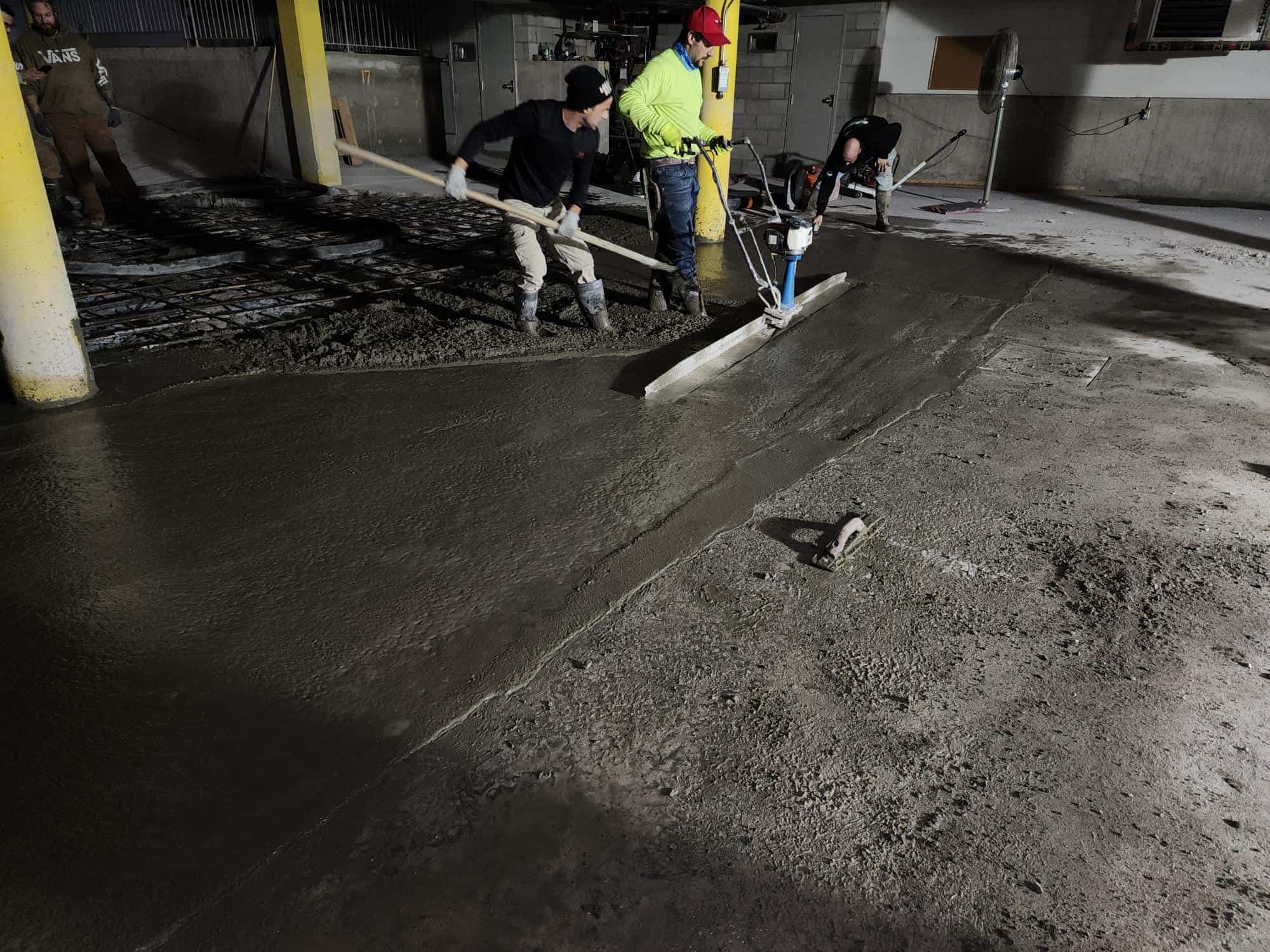
- Leveling and screeding
- Surface finishing to meet use requirements
- Joint cutting at appropriate timing
- Curing to support strength development
ASTM standards outline testing and performance requirements for concrete used in floor slabs⁴.
Concrete Strength and Material Selection
Concrete used in slab construction is specified based on strength and exposure conditions.
Commercial and industrial slabs commonly use concrete strengths of 25 MPa to 35 MPa, depending on design requirements².
Material selection also considers:
- Durability
- Shrinkage behavior
- Compatibility with reinforcement
- Surface wear resistance
CSA standards govern materials and construction practices used in Canadian concrete projects².
Environmental Exposure in Montreal Concrete Slab Construction
Montreal concrete slabs are exposed to environmental conditions that affect performance.
These include:
- Seasonal temperature changes
- Moisture from rain and snow
- Interior exposure to tracked-in water
- Contact with de-icing products
Quebec applies approximately 1.5 million tonnes of de-icing salt each winter, much of which is tracked into buildings by vehicles and foot traffic¹.
Slab construction must account for these conditions to support durability.
Scale of Concrete Slab Construction
Concrete slabs are a standard construction element worldwide.
- Global cement production reached approximately 4.2 billion tonnes in 2020, supporting widespread use of concrete floors and infrastructure⁵.
- In Canada, over 13 million metric tonnes of cement are produced annually, reflecting ongoing commercial and industrial construction activity⁶.
These figures highlight how common slab construction is as part of the built environment.
New Slab Construction Versus Replacement
Concrete slab construction may involve new installation or replacement of existing slabs.
New slab construction is common when:
- Buildings are newly constructed
- Floor layouts are modified
- Load requirements increase
- Equipment installations change
Replacement may be required when existing slabs are severely damaged or no longer meet performance requirements.
Evaluating site conditions helps determine the appropriate approach.
Safety and Compliance
Concrete slab construction must comply with applicable building codes and safety regulations.
Key considerations include:
- Structural performance
- Surface safety and slip resistance
- Accessibility requirements
- Integration with fire and mechanical systems
In Quebec, concrete construction must comply with requirements overseen by the Régie du bâtiment du Québec⁷.
Our credentials. Les Services de Béton Universel Ltée holds RBQ licence 5754-4876-01 and carries two million dollars per occurrence and five million aggregate in liability insurance, and our crews work to CNESST safety standards on every site. We are members of the ACQ, the CCQ, the American Concrete Institute (ACI), and the International Concrete Repair Institute (ICRI). You can view or download our Certificate of insurance (PDF), the licence can be checked on the public Régie du bâtiment du Québec registry under number 5754-4876-01, and our Quebec enterprise number (NEQ) is 1171982201.
Concrete Slab Construction as Part of Broader Projects
Concrete slabs are often constructed alongside:
- Foundations and footings
- Structural concrete elements
- Drainage and trench systems
- Machine foundations
Les Services de Béton Universel Ltée integrates slab construction into comprehensive commercial and industrial concrete projects across Montreal, Laval, and the South Shore.
When Concrete Slab Construction Is Needed
Concrete slab construction is typically required when:
- New buildings are developed
- Existing floors are replaced
- Industrial equipment is installed
- Building layouts change
- Load demands increase
Proper planning ensures slabs meet current and future use requirements.
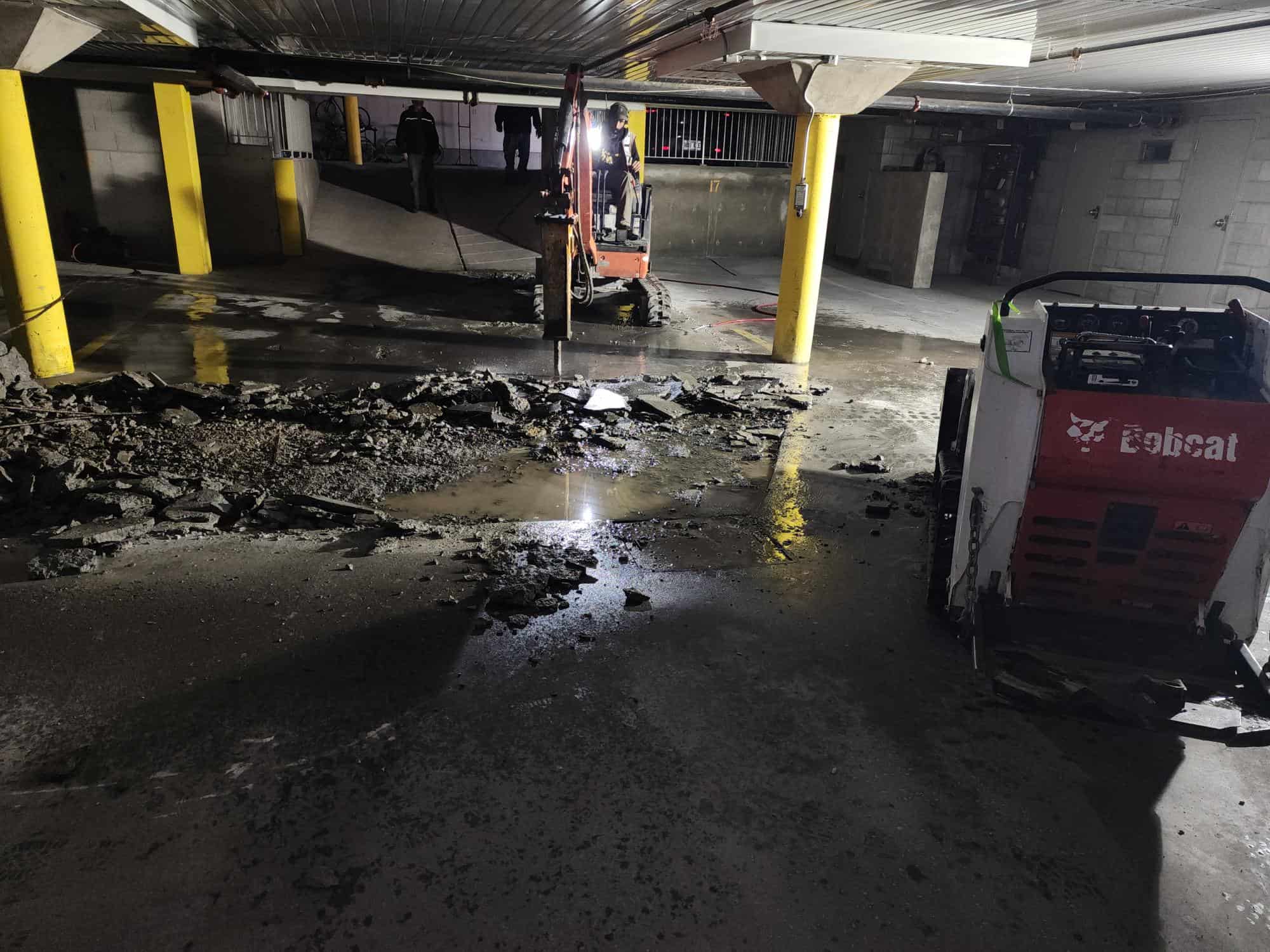
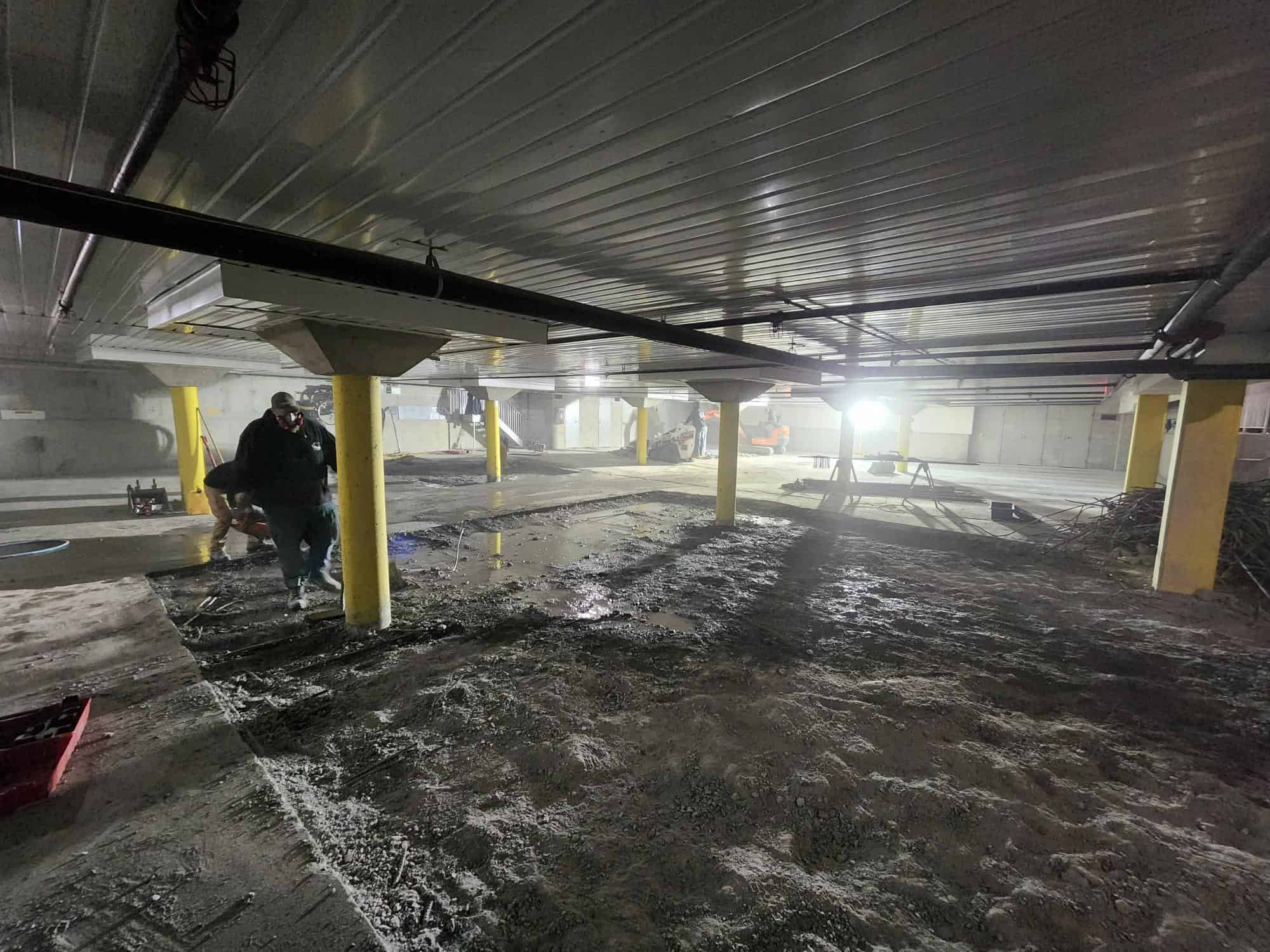
Warehouse slab replacement
| Before | After |
 |  |
A warehouse aisle concrete slab removed and replaced with new wire mesh and expert concrete finishing.
Key Takeaways
- Concrete slabs support daily operations in commercial and industrial buildings
- Thickness and reinforcement depend on load requirements
- Subbase preparation is critical to performance
- Joints help control cracking
- Concrete slabs are a standard, durable flooring solution
Concrete slab construction plays a vital role in maintaining functional, durable, and safe commercial and industrial facilities throughout the Greater Montreal area.
Resources
¹ Gouvernement du Québec – De-icing salt use
https://www.environnement.gouv.qc.ca/eau/flrivlac/sels-dissous-en.htm
² CSA Group – CSA A23.1 / A23.2 Concrete Materials and Methods
https://www.csagroup.org/store/product/CSA%20A23.1%3A19-CSA%20A23.2%3A19/
³ National Research Council Canada – Soil Support and Concrete Performance
https://nrc-publications.canada.ca/eng/view/accepted/?id=2fd85efa-fdee-4403-8f3f-2ead000c4ece
⁴ ASTM International – Concrete Floor and Slab Standards
https://www.astm.org/standards/c94
⁵ Global Cement and Concrete Association – Cement and concrete production
https://gccassociation.org/concretefuture/cement-concrete-around-the-world/
⁶ Statistics Canada – Cement manufacturing and production
https://www150.statcan.gc.ca/t1/tbl1/en/tv.action?pid=1610007701
⁷ Régie du bâtiment du Québec – Construction and concrete work requirements
https://www.rbq.gouv.qc.ca/