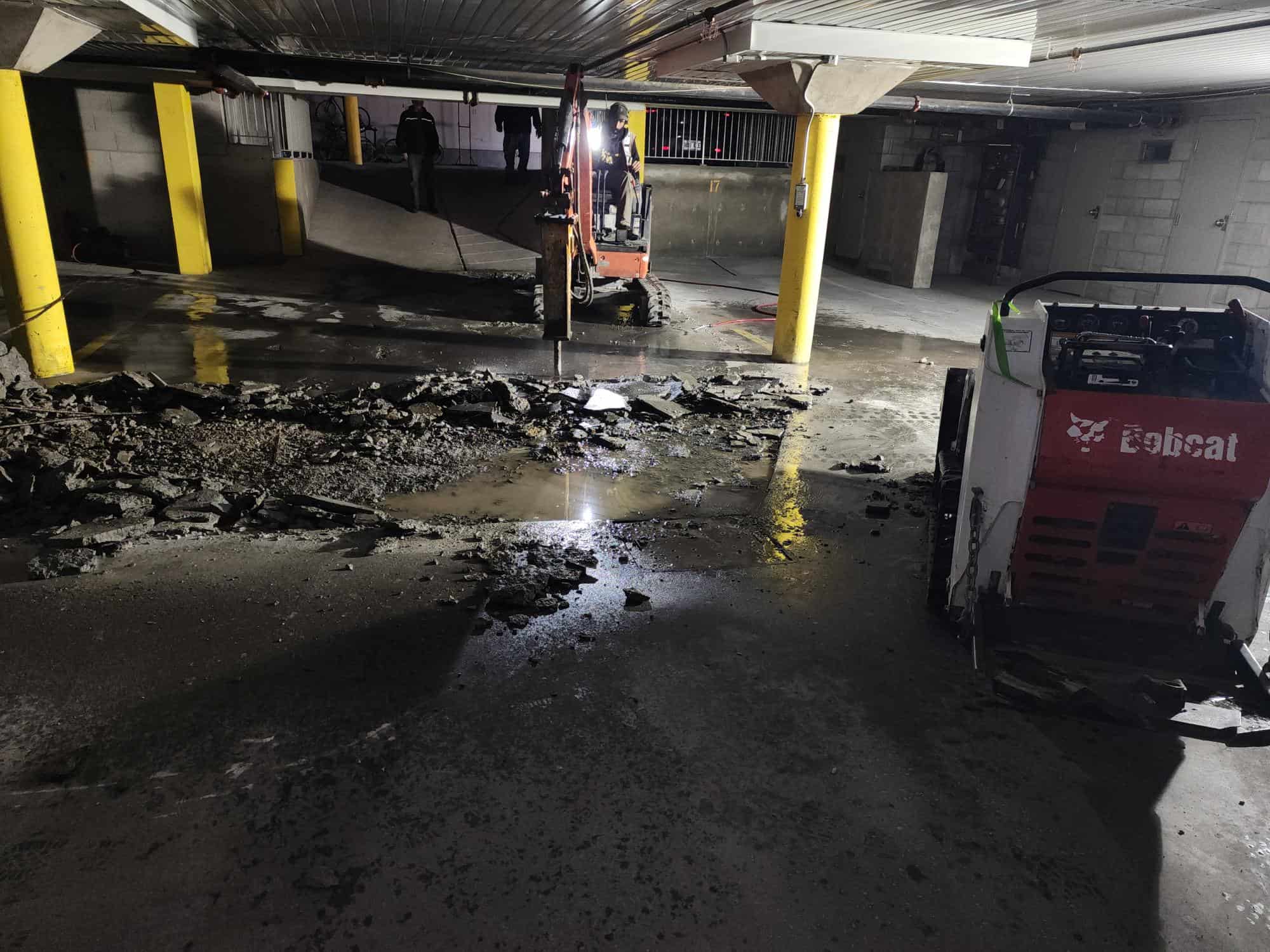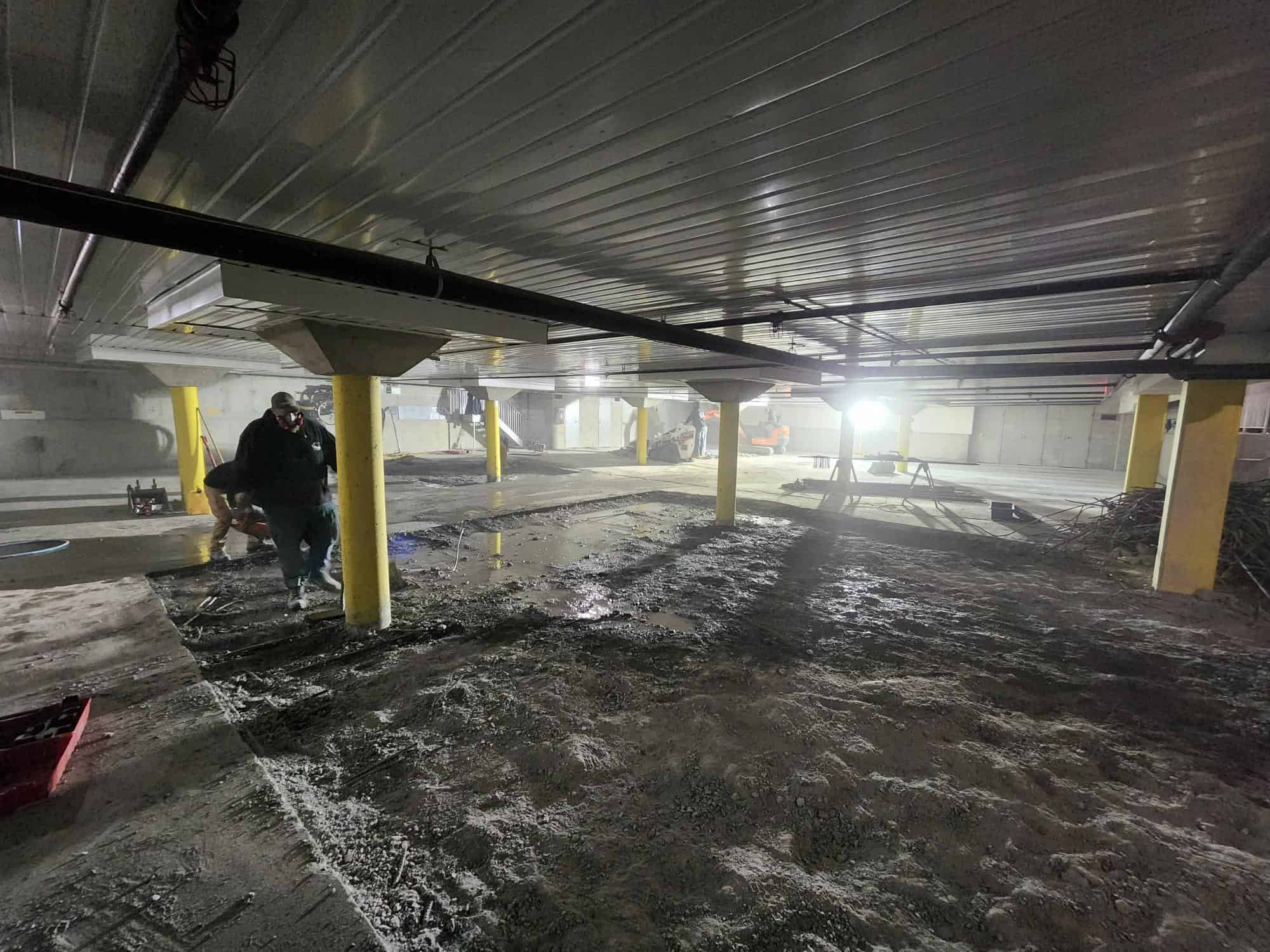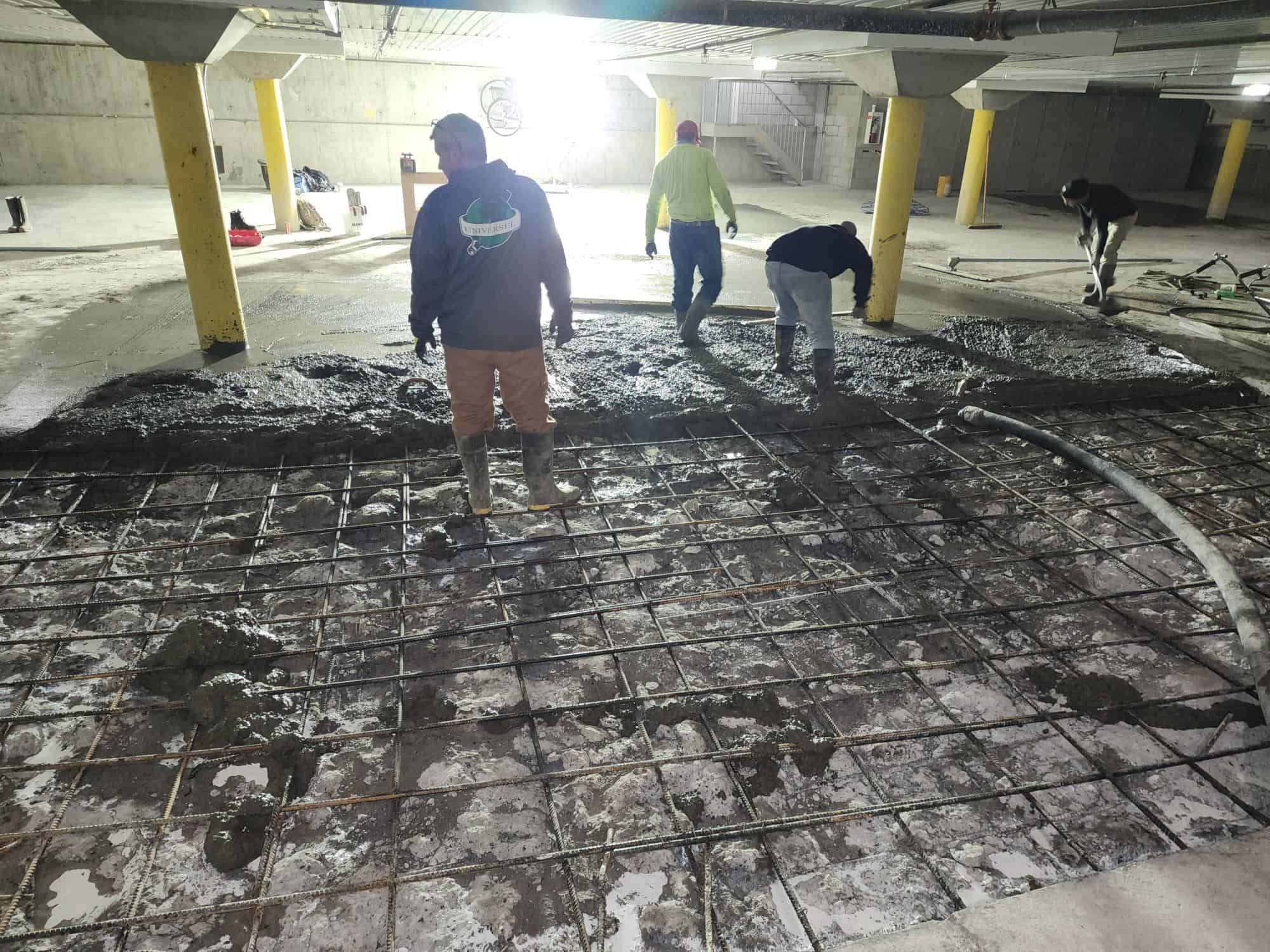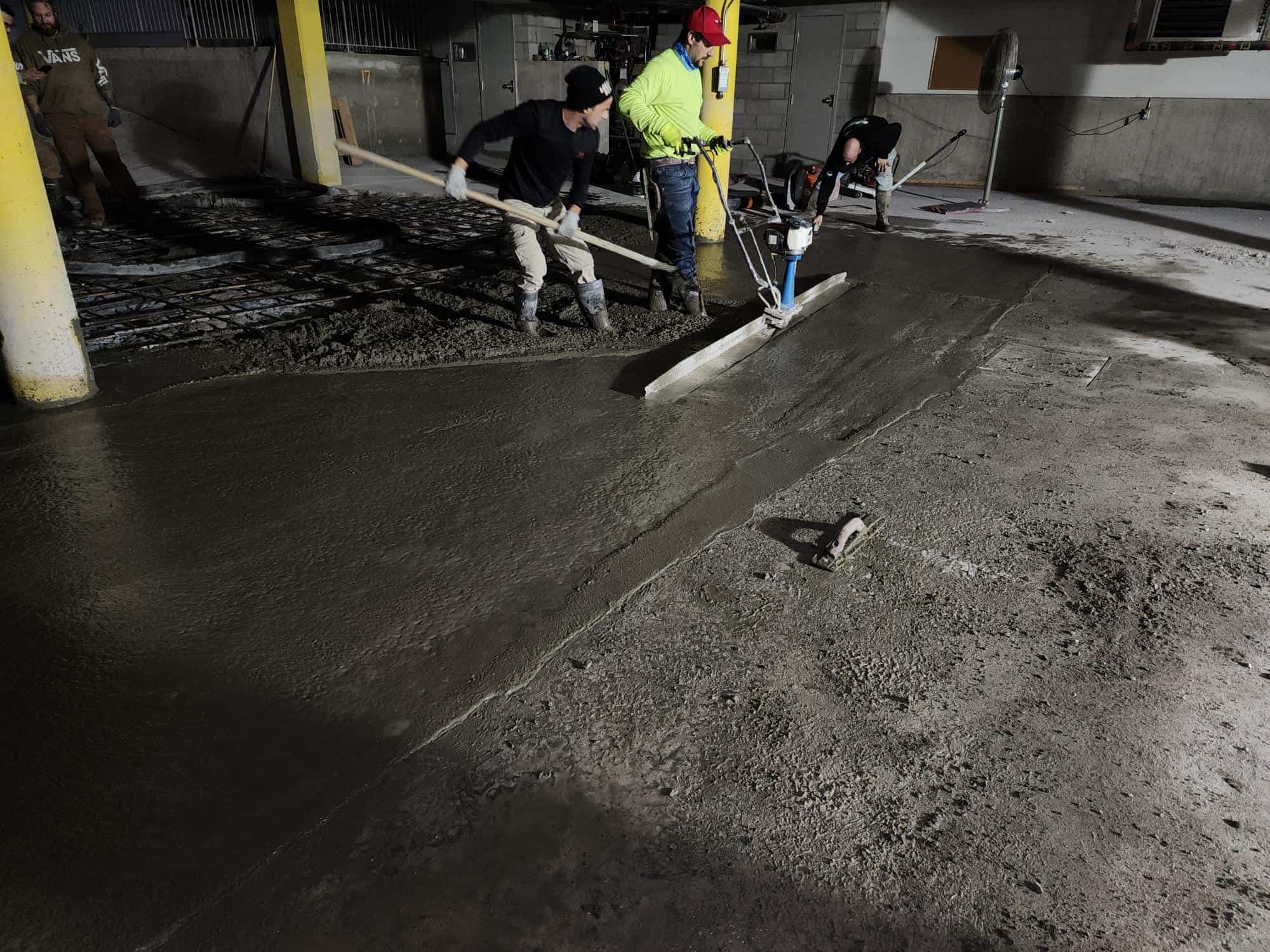
Reinforced concrete is one of the most widely used structural materials in commercial and industrial construction. It combines concrete’s compressive strength with the tensile strength of embedded steel reinforcement. Together, these materials allow buildings to support heavy loads, resist movement, and perform reliably over long service lives.
When reinforced concrete deteriorates, the issue is rarely limited to the surface. Damage often affects the interaction between concrete and steel, which can reduce strength, durability, and load-carrying capacity.
Reinforced concrete repair focuses on restoring the performance of both materials so the structure can continue to function safely.
Les Services de Béton Universel Ltée provides reinforced concrete repair services for commercial and industrial buildings throughout Greater Montreal, working in coordination with engineers and property managers.
How Reinforced Concrete Works
Reinforced concrete relies on a balance between two materials:
- Concrete, which performs well in compression
- Steel reinforcement, which resists tension and controls cracking
Steel reinforcement is placed within the concrete to handle tensile forces created by loads, movement, and temperature changes. Concrete protects the steel by providing physical cover and limiting exposure to moisture and oxygen.
When this balance is maintained, reinforced concrete performs efficiently. When it is disrupted, deterioration can occur.
Where Reinforced Concrete Is Commonly Used
Reinforced concrete is used in a wide range of commercial and industrial applications, including:
- Structural slabs and floors
- Beams and columns
- Parking garages
- Foundations and retaining walls
- Industrial equipment supports
Because reinforced concrete elements are often interconnected, deterioration in one area can affect adjacent components.
Common Causes of Reinforced Concrete Deterioration
Reinforced concrete can deteriorate for several reasons over time. The most common causes involve changes to the protective environment surrounding the steel reinforcement.
Typical causes include:
- Cracking that allows moisture penetration
- Corrosion of reinforcing steel
- Loss of concrete cover
- Repeated loading and unloading
- Long-term exposure to moisture
Once steel reinforcement begins to corrode, it expands. This expansion places pressure on the surrounding concrete, often leading to cracking and spalling.
The International Concrete Repair Institute notes that reinforcement corrosion is a leading factor in reinforced concrete repair projects¹.
Concrete Cover and Reinforcement Protection
Concrete cover refers to the thickness of concrete between the reinforcing steel and the exposed surface. Adequate cover helps protect steel from moisture, chlorides, and other corrosive agents.
Insufficient cover can result from:
- Design limitations
- Construction tolerances
- Surface wear over time
- Previous repairs
Canadian concrete standards establish minimum cover requirements to protect reinforcement in different exposure conditions².
Crack Formation and Structural Performance
Cracking is a normal characteristic of reinforced concrete. However, not all cracks are the same.
Cracks that may require repair include:
- Cracks that widen over time
- Cracks that expose reinforcement
- Cracks associated with corrosion staining
- Cracks that affect load transfer
Repair methods are selected based on crack width, depth, and cause.
Environmental Exposure in Commercial Structures
Reinforced concrete in commercial buildings is often exposed to challenging environments.
In Quebec, winter maintenance practices increase exposure to moisture and chlorides. Provincial data indicates that approximately 1.5 million tonnes of de-icing salt are used each winter, much of which is carried into parking structures and service areas by vehicles and foot traffic³.
This exposure increases the risk of chloride penetration into reinforced concrete elements.
Scale of Reinforced Concrete Use
Reinforced concrete is used globally at a large scale.
- Global cement production reached approximately 4.2 billion tonnes in 2020, supporting widespread reinforced concrete construction worldwide⁴.
- In Canada, over 13 million metric tonnes of cement are produced annually, reflecting continued use of reinforced concrete in commercial and industrial buildings⁵.
These figures highlight why reinforced concrete repair is a routine part of maintaining the built environment.
Evaluation of Reinforced Concrete Condition
Before repairs begin, reinforced concrete elements are evaluated to determine the extent of deterioration.
Evaluation methods may include:
- Visual inspection for cracking and spalling
- Sounding to identify delaminated areas
- Assessment of reinforcement exposure
- Review of structural drawings and load conditions
Understanding the cause of deterioration helps ensure repairs restore both strength and durability.
Les Services de Béton Universel Ltée works with engineers to assess reinforced concrete elements and develop appropriate repair strategies.
Reinforced Concrete Repair Methods
Repair methods are selected based on the type and severity of deterioration.
Common reinforced concrete repair approaches include:
| Condition | Repair Focus |
|---|---|
| Surface spalling | Removal of damaged concrete and patch repair |
| Corroded reinforcement | Cleaning, treatment, and re-encapsulation |
| Cracking | Crack repair and sealing |
| Loss of section | Section restoration |
Proper surface preparation is critical to achieving durable repairs. ASTM standards provide guidance on bonding and material performance for concrete repairs⁶.
Compatibility of Repair Materials
Repair materials must be compatible with existing concrete and reinforcement. Incompatible materials can lead to differential movement, cracking, or premature failure.
Compatibility considerations include:
- Thermal expansion
- Elastic modulus
- Bond strength
- Durability in exposure conditions
Selecting appropriate materials helps repairs perform as intended.
Repair Versus Replacement in Reinforced Concrete Structures
In many cases, repairing reinforced concrete is preferred over full replacement. Replacement can involve extensive demolition and disruption.
Repair allows targeted restoration of deteriorated areas while preserving the original structure.
Structural rehabilitation as a standard practice for extending the service life of buildings.
When Reinforced Concrete Repair Is Needed
Reinforced concrete should be evaluated for repair when:
- Reinforcement becomes exposed
- Cracking and spalling increase
- Rust staining appears
- Load demands change
- Building use is modified
Early intervention helps limit repair scope and maintain structural performance.
In Quebec, reinforced concrete repairs must comply with provincial construction requirements overseen by the Régie du bâtiment du Québec⁷.
Reinforced Concrete Repair as Part of Building Maintenance
Reinforced concrete repair is often part of broader maintenance programs that include:
- Beam and column repair
- Slab repair
- Parking garage rehabilitation
- Drainage and waterproofing improvements
Les Services de Béton Universel Ltée integrates reinforced concrete repair into comprehensive maintenance and rehabilitation projects across Montreal, Laval, and the South Shore.
Key Takeaways
- Reinforced concrete relies on both concrete and steel
- Corrosion of reinforcement is a common cause of deterioration
- Concrete cover plays a critical role in protection
- Repair restores strength and durability
- Early evaluation reduces long-term impact
Reinforced concrete repair supports the continued safe use of commercial and industrial buildings throughout the Greater Montreal area.
Resources
¹ International Concrete Repair Institute – Guideline 310.1R
https://store.icri.org/item/3101r2008-english-pdf-guideline-surface-preparation-repair-deteriorated-concrete-resulting-reinforcing-steel-corrosion-342512
² CSA Group – CSA A23.1 / A23.2 Concrete Materials and Methods
https://www.csagroup.org/store/product/CSA%20A23.1%3A19-CSA%20A23.2%3A19/
³ Gouvernement du Québec – De-icing salt use
https://www.environnement.gouv.qc.ca/eau/flrivlac/sels-dissous-en.htm
⁴ Global Cement and Concrete Association – Cement and concrete production
https://gccassociation.org/concretefuture/cement-concrete-around-the-world/
⁵ Statistics Canada – Cement manufacturing and production
https://www150.statcan.gc.ca/t1/tbl1/en/tv.action?pid=1610007701
⁶ ASTM International – Bonding Concrete and Repair Standards
https://www.astm.org/standards/c881
⁷ Régie du bâtiment du Québec – Construction and concrete work requirements
https://www.rbq.gouv.qc.ca/