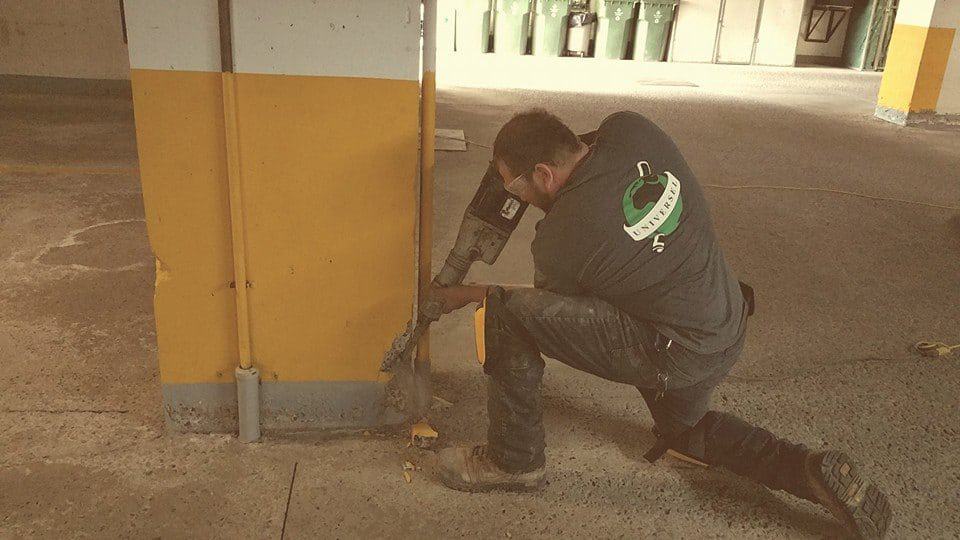
Concrete columns are critical structural elements in commercial and industrial buildings. They transfer loads from beams, slabs, and roofs down to foundations, helping maintain stability throughout the structure. In many buildings, columns also resist bending forces created by uneven loading, vehicle movement in garages, or changes in the building’s use over time.
When a concrete column deteriorates, the issue should be evaluated quickly. Columns carry vertical loads. If a column is compromised, the building’s load path can change and stress may increase in nearby elements.
Concrete column repair focuses on restoring load-carrying capacity, durability, and long-term performance while keeping the structure safe and operational.
Les Services de Béton Universel Ltée provides concrete column repair services for commercial and industrial buildings throughout Greater Montreal, working closely with engineers and property managers to address structural issues efficiently.
The Role of Concrete Columns in Commercial Buildings
In commercial and industrial construction, concrete columns support vertical loads and transfer them safely to foundations. Concrete Columns often work as part of a frame with beams and slabs, and in many buildings they also contribute to lateral stability through the way they connect with other structural members.
Concrete columns are common in:
- Underground concrete parking garages
- Warehouses and industrial facilities
- Commercial buildings with open floor layouts
- Structures supporting heavy storage systems and mezzanines
According to the American Concrete Institute¹, reinforced concrete columns must resist axial loads and, depending on layout, bending forces as well. Column performance depends on the integrity of both the concrete and the reinforcing steel inside.
Common Reasons Concrete Columns Require Repair
Concrete columns can deteriorate due to environmental exposure, aging materials, and job-site conditions that are specific to commercial environments.
Common causes include:
- Concrete spalling that exposes reinforcing steel
- Corrosion of internal reinforcement
- Impact damage (vehicles, forklifts, loading equipment)
- Cracking caused by stress concentrations at connections
- Water infiltration from slabs, joints, or drainage issues
- Long-term exposure to chlorides in parking structures
This is one reason column repair is frequently tied to overall building maintenance programs, especially in garages and industrial facilities.
The International Concrete Repair Institute² emphasizes that correct diagnosis and preparation are central to repair performance.
Common Reinforced Concrete Column Damage
Columns are likely to be affected by:
- Impact zones near parking stalls, ramps, and drive lanes
- Base deterioration at slab interfaces where water and debris collect
- Connection stress where beams frame into columns
- Localized “ring” cracking around reinforcement and ties
Practical Province of Quebec Exposure Reality
Concrete columns in Underground concrete parking garages and commercial buildings are often exposed to conditions that accelerate wear. In the Province of Quebec, winter operations play a major role in this exposure.
Provincial data indicates that approximately 1.5 million tonnes of de-icing salt are used each winter³. Chlorides from these salts are tracked into parking structures and accumulate around column bases, joints, and slab interfaces.
At a broader scale, the Global Cement and Concrete Association reports global cement production of approximately 4.2 billion tonnes per year⁴, underscoring how common reinforced concrete structures are worldwide and why long-term maintenance of columns is standard practice in commercial construction.
How Concrete Column Damage Is Evaluated
Column repair should start with a clear evaluation. Depending on the site and the type of damage, that evaluation may include:
- Visual inspection for cracking, spalling, and rust staining
- Sounding tests for delamination
- Checking for exposed reinforcement and corrosion
- Reviewing impact history (common in garages)
- Reviewing changes in usage and loading (new equipment, storage changes)
The goal is to understand not only what failed, but why it failed, so repairs last.
Les Services de Béton Universel Ltée regularly collaborates with engineers to assess concrete columns and develop repair plans that align with building requirements and safety standards.
Typical Concrete Column Repair Methods
Column repair methods depend on severity, location, and the role of the column in the structure.
Common approaches include:
| Condition | Repair Focus |
|---|---|
| Surface deterioration | Removal of loose concrete and patch repair |
| Corrosion damage | Rebar cleaning, treatment, and re-encapsulation |
| Impact damage | Section restoration and strengthening |
| Connection cracking | Crack repair and localized reinforcement |
Good repairs depend heavily on surface preparation and bond. ASTM testing standards such as ASTM C881 are commonly used as a reference for bonding materials and repair performance.⁵
Structural Concrete Repair Versus Replacement of Concrete Columns
Full replacement of a structural column can involve:
- Extensive shoring
- Demolition and reconstruction
- Major disruption to building operations
- Longer timelines and higher overall costs
In many commercial settings, repair is preferred when it can safely restore capacity and durability without major downtime.
Structural rehabilitation is a standard approach for extending the service life of buildings.
When Concrete Columns Should Be Assessed
Concrete columns should be evaluated when you notice:
- Rust staining, exposed rebar, or recurring spalling
- Cracking that changes over time
- Evidence of impact damage
- Water pooling at column bases
- Changes in building use that may increase loads
Early evaluation tends to reduce repair scope and helps avoid larger structural interventions later.
In Quebec, structural concrete work must comply with provincial construction requirements overseen by the Régie du bâtiment du Québec⁶.
Key Takeaways
- Columns are core load-carrying elements in commercial and industrial buildings
- Column damage often involves impact zones, base deterioration, and corrosion
- Early evaluation and correct preparation improve repair performance
- Repair is often a practical alternative to full replacement
Les Services de Béton Universel Ltée provides concrete column repair services across Montreal, Laval, and the South Shore, often coordinated with broader structural maintenance and rehabilitation work.
Resources
¹ American Concrete Institute – Reinforced Concrete Columns
https://www.concrete.org/topicsinconcrete/topicdetail/reinforced%20concrete%20columns
² International Concrete Repair Institute – Guideline 310.1R
https://store.icri.org/item/3101r2008-english-pdf-guideline-surface-preparation-repair-deteriorated-concrete-resulting-reinforcing-steel-corrosion-342512
³ Gouvernement du Québec (Environment) – Road salt use in Québec
https://www.environnement.gouv.qc.ca/eau/flrivlac/sels-dissous-en.htm
⁴ GCCA – Cement and concrete around the world (global figures)
https://gccassociation.org/concretefuture/cement-concrete-around-the-world/
⁵ ASTM – ASTM C881 (bonding concrete)
https://www.astm.org/standards/c881
⁶ RBQ – Building work / requirements (Quebec)
https://www.rbq.gouv.qc.ca/en/